AI Assurance
An AI That Posts for Clinics: Six Checks Before It Goes Live
An AI that writes a clinic’s posts speaks in its name, in a regulated sector, and learns from engagement. My six pre-launch checks, applied to Badee.
An AI that writes a clinic's social media looks like a low-risk agent. It never touches money or patient records. But it speaks in the clinic's name, in public, in a sector where advertising is regulated. And it is built to learn from whatever gets engagement. That combination deserves the same pre-launch gate as any agent that acts for a business.
In my pre-launch checklist I set out six questions an AI agent should answer before it meets customers. Here they are, applied to a real one: Badee, the AI marketing app BRev Digital built for clinics in Dubai.
Disclosure: I work with BRev Digital on AI strategy and AI auditing, so read this as an insider's walk-through of the controls, not an independent review.
1. Can you say exactly what it is allowed to do?
Badee's job in one sentence: turn a clinic's own brand into a week of on-brand posts and Reels, and publish them once the clinic says yes. That sentence already limits it.
It works from the clinic's own material: its photos, logo, fonts, colours and brand manual, set up when the clinic is onboarded. A narrow input is a narrow way to fail.
It publishes only to the Facebook and Instagram accounts the clinic has connected. TikTok and YouTube are export-only: the app hands over the file and a person posts it.
Nothing is published without the clinic's approval. That is the one irreversible action, and it sits behind a person.
2. Have you tested it against its real job?
The real job is not "make a nice image". It is three narrower questions: does this look like this clinic and nobody else, is the claim allowed, and is it right in both languages? An evaluation set for an agent like this should hold all three:
Brand fidelity: the right logo, colours and fonts, every time, including the awkward photo and the long clinic name.
Wording that must be caught: claims that health-advertising rules do not allow, written the way a busy marketer would actually phrase them, not just the textbook examples.
Both languages: the copy comes in English and Arabic, so the Arabic needs a native reader in the loop, not a back-translation.
3. What happens when someone tries to break it?
The attack surface is smaller than a chatbot's, because the public never talks to it. The inputs are the clinic's brief and the files it uploads. Treat those as data, never as instructions: a line in a brief that says "ignore the brand rules" should change nothing. The approval step is the backstop. Whatever slips through still has to get past a person before it reaches the feed.
4. Who takes over when it is unsure?
This is where Badee is strongest, and it is worth copying.
The AI flags wording that the UAE's health-advertising rules do not allow. It does not quietly rewrite it. The clinic sees the flag and decides.
A Reel cannot be approved until the clinic's advertising licence number is on file, and the closing card carries it. The rule is enforced by the software, not left to memory.
The clinic approves a week at a time, so a person looks at every post before it is scheduled.
A hard gate in code beats a reminder in a manual every time.
5. Does the learning loop stay inside the lines?
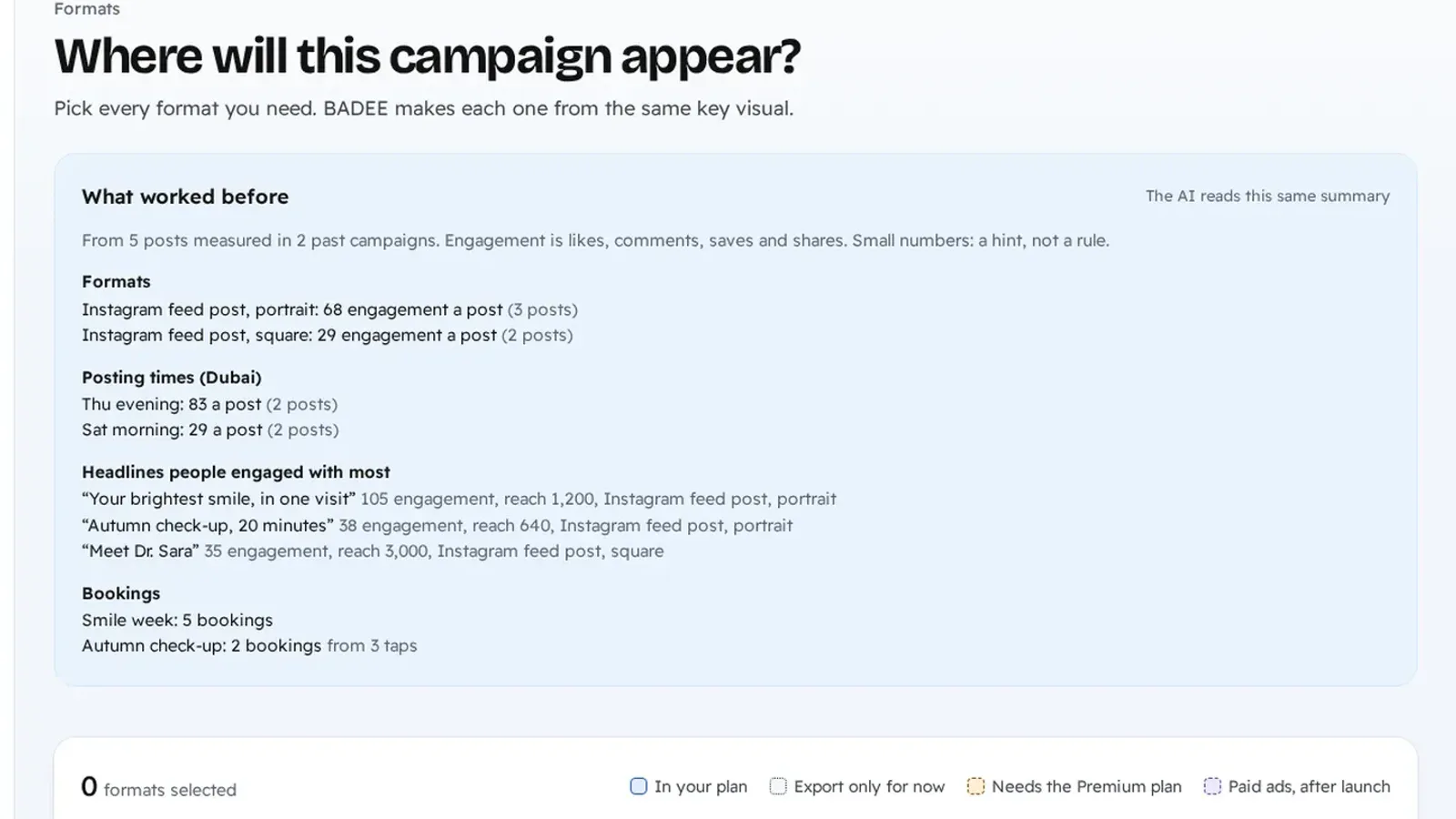
This is the question most teams skip. Badee measures each post and every tap on the clinic's booking link, and the AI reads what worked (formats, posting times, headlines, bookings) into the next campaign's brief. That is the feature agencies never delivered. It is also a risk: in healthcare marketing, the exaggerated claim is often the one that performs.
The control is where the learning is allowed to act. It shapes the brief. It does not get to skip the wording flags, the licence gate or the clinic's approval. When I review a system with a feedback loop, I ask two more things: can you see which signal shaped which brief, and are the flags rising or falling month on month? A loop you cannot inspect is a loop you cannot trust.
6. Which rules actually apply?
Two sets. The health-advertising rules decide what a post may claim, which is why the licence number and the wording flags exist. And data protection decides what the agent may see. A marketing agent has no reason to see patient records, so the cleanest design is one where it never can: brand assets and engagement numbers in, posts out.
The short version
Let the AI do the work: the design, the copy, the planning. Put people and plain code on the three things that cannot go wrong: what gets published, what gets claimed, and what the next campaign learns. BRev has written up six agents built to that same shape, from site reports to audit drafts.
If you are about to launch an agent of your own and want a second pair of eyes on these six questions, that is what my AI assurance work is for.